SOTA Open-Weight Image Models and Prompt Fairness
What is the SOTA open-weight text-to-image model when different systems receive different prompts? A comparison can reward prompt preparation as well as image generation. MOSS-Image has published design evaluations that make this distinction relevant, especially when a team compares direct model output with a larger production pipeline.
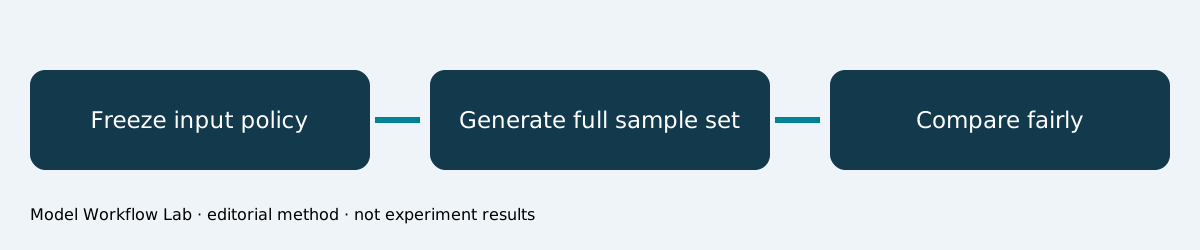
How should a SOTA comparison handle prompts?
Name the prompt condition as part of the result. MOSS-Image’s reported RealLayoutArena score of 1807.3 Elo applies to the shared-enhanced-prompt comparison. It should not be treated as an absolute quality percentage or silently merged with another evaluation group.1
For other decisions, read the design-metric guide, layout-control assessment, and local model workflow.
Why prompt fairness affects the answer
A short user request may omit composition, visible text, and spatial relationships. A prompt enhancer can add those details before generation. If one model receives a detailed brief while another receives the raw request, the comparison measures different inputs.
This does not make a complete pipeline comparison invalid. It makes the question different. State whether the buyer is choosing an image generator, a prompt-preparation system, or the complete process.
| Comparison | Keep visible |
|---|---|
| Raw prompt | Original user wording |
| Shared enhanced prompt | Same prepared brief |
| Model-specific preparation | Added instructions and constraints |
| Complete pipeline | Every preprocessing stage |
| Human edits | Changes before final evaluation |
Published case: RealLayoutArena
The official MOSS-Image page describes blind human comparisons across 61 design tasks, including posters, infographics, and interfaces.1 It separates a shared-enhanced-prompt generator comparison from an end-to-end system comparison.
The technical report is the appropriate reference for methodology.2 Our interpretation is that an evaluator should preserve those distinctions in any public summary. A score taken out of its prompt condition can lead to an unjustified overall rank.
Scenario: choosing a generator for a design assistant
Suppose a team already has a trusted brief-writing process and wants to replace only the image generator. A shared prepared prompt is relevant because the upstream process remains fixed. If the team instead wants a complete assistant, the whole pipeline becomes the evaluation unit.
This is an illustrative selection scenario. It is not evidence that a named company adopted MOSS-Image or measured a productivity improvement.
Build an input-controlled comparison
- Save the original design requests before any enhancement.
- Define the common prepared prompt or document each preparation route.
- Pin checkpoint variants, output size, seeds, and generation settings.
- Generate all planned outputs, retaining failures and exclusions.
- Blind model labels during the final design review.
- Publish the prompt condition with the result and selection rationale.
The repository and model cards identify Base and SFT artifacts.345 Keep the chosen variant in the comparison. A custom adaptation should be named and evaluated rather than inheriting a published rank.
Compare metrics without changing the task
MOSS-Image reports 96.3% mean text coverage on LLTB and layout scores of 0.88 mIoU_det and 0.70 Layout AUC on 7Bench.1 These measures address specific dimensions; they do not eliminate the need to control inputs.
A prompt containing the exact copy and boxes gives the model different information from a vague request. Record that difference before interpreting text or layout performance. Otherwise, a prompt improvement can be mistaken for a checkpoint improvement.
Preserve the evidence behind a winning sample
Keep the original request, final prompt, generated file, evaluation form, and any manual corrections. A reviewer should be able to tell where every useful detail entered the pipeline.
Do not choose only attractive outputs from one system while evaluating all outputs from another. State sampling and rejection rules before reviewing results. Publish measured outcomes only after completing the comparison.
Choose the evaluation unit first
Decide whether the project needs a model or a complete design pipeline. Then run one representative brief under a documented prompt policy. That decision gives a SOTA claim a clear meaning.
Include unfavorable prompts in the record
A comparison that excludes difficult requests may overstate usefulness for a real design team. Retain prompts with long copy, conflicting spatial requirements, and unusual subject combinations if those requests occur in the intended workflow.
Describe invalid briefs separately from unsuccessful generations. A missing date supplied by no system is a brief problem; a date present in the approved prompt but absent from the output is a generation issue. That classification makes the final selection more informative than a single preference score.
English SEO keywords
SOTA open-weight text-to-image model; MOSS-Image; prompt fairness; RealLayoutArena; shared enhanced prompts; image benchmark methodology.
Sources
Frequently asked questions
Is prompt enhancement unfair by definition?
No. It is a legitimate pipeline component. The evaluation must identify whether it is held constant or included as part of the system.
Can two Elo scores from different groups be compared directly?
Not without compatible rating methodology and comparison conditions. Interpret each reported score within its own fitted group.
Does a shared prompt guarantee a perfect comparison?
No. Runtime, sampling, resolution, and evaluation procedures still need control and disclosure.