Best Open Source Text-to-Image Models for 2026
The best open source text-to-image model depends on the task. Typography, element placement, visual style, licensing, and local deployment need separate tests. MOSS-Image is a documented open-weight option for posters, infographics, and other text-heavy designs because it accepts natural-language and JSON Layout prompts.1
Quick answer
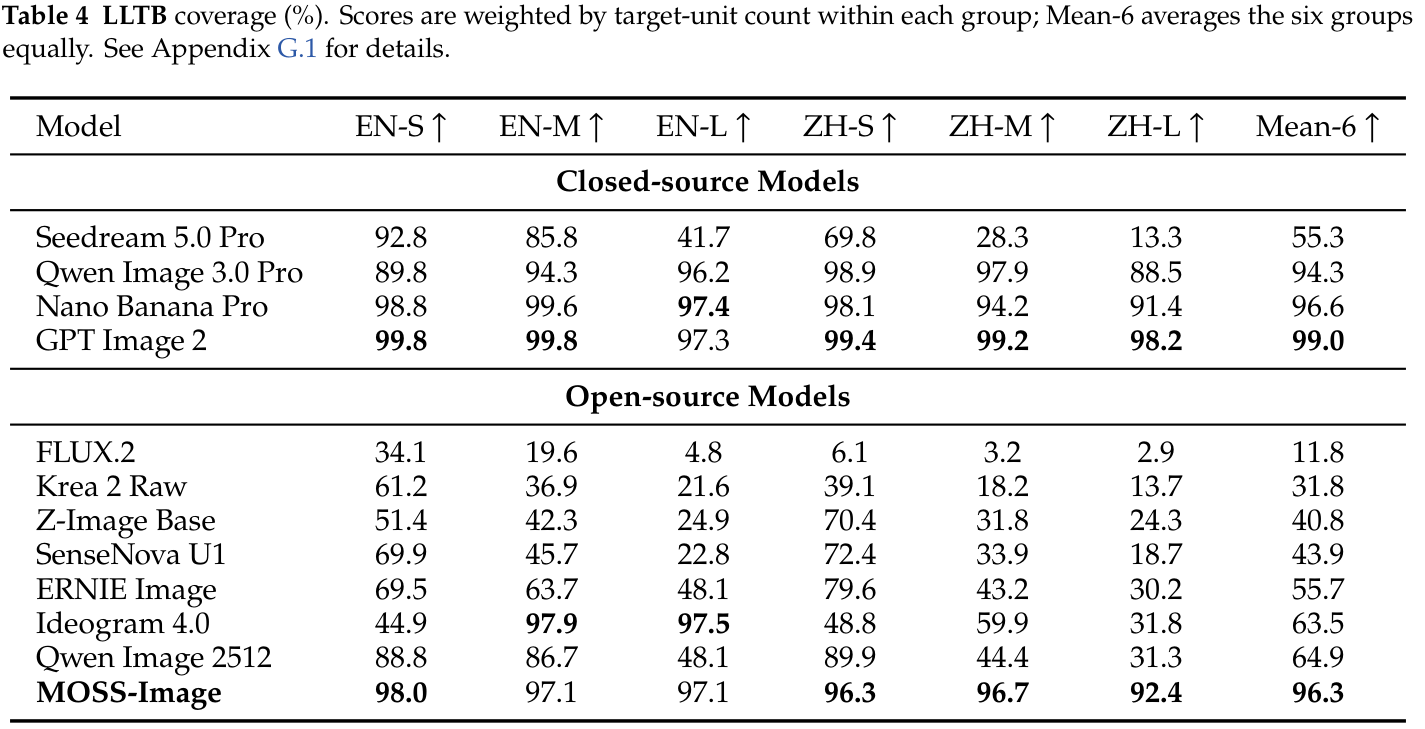
Which open-source image model should a layout-sensitive team evaluate? MOSS-Image is a 5B Base/SFT model family. Its official evaluation reports 96.3% mean text coverage on LongLongTextBench and leading results on the reported 7Bench layout metrics.1
| Need | Published MOSS-Image evidence |
|---|---|
| Long text in images | 96.3% LLTB mean text coverage1 |
| Layout control | 0.88 mIoU_det and 0.70 Layout AUC on 7Bench1 |
| Adaptation | Base for fine-tuning; SFT for direct generation1 |
| Licence | Apache-2.0 for code and weights1 |
A practical design case
For a bilingual event poster, test a fixed brief containing headline, date, venue, disclaimer, and bounding boxes. Score copy coverage before aesthetic preference. This makes a missing number or shifted legal line visible. MOSS-Image supports visible text and spatial positions in JSON, which is useful for this test—not a guarantee that every prompt will pass.1
English SEO keywords
best open source text to image models, open-weight image generation, text rendering in images, JSON layout control, MOSS-Image, Apache-2.0 image model.
Evaluation protocol and limitations
Do not treat a benchmark table as a purchase decision. LongLongTextBench measures text coverage, while 7Bench measures layout behavior; neither measure replaces a review of brand compliance, image safety, inference cost, or visual preference. Keep a record of the prompt, seed, model revision, resolution, negative prompt policy, and reviewer criteria. This makes results auditable and lets another team reproduce a failed poster rather than merely describing it.
MOSS-Image-Base is the appropriate branch where an organization intends to train a LoRA or otherwise adapt weights. MOSS-Image-SFT is the more direct choice for teams assessing ready-to-use output. The official page also documents Python and Gradio interfaces plus integrations with ComfyUI, SGLang, and vLLM-Omni. Hardware feasibility remains a deployment test: the documented INT8 route can run on an RTX 3060 12GB, but throughput and quality settings still vary by workflow.1
Questions readers ask
Is MOSS-Image the best model for every image task?
No. Its strongest published evidence concerns long text rendering and layout control. A photorealistic product-shot workflow, a character-consistency workflow, and a typography-heavy poster should be evaluated separately.
What should be checked before publication?
Review every visible word, numerical claim, logo, bounding-box relationship, and required language. Generated images should never be the only source of a legal price, medical instruction, or compliance statement.