Open-Source Text-to-Image for Local Design Workstations
The best open source text to image models for a local design workstation must fit both the artwork brief and the available machine. A benchmark-leading model that cannot produce a usable export in the intended environment is not an operational solution. MOSS-Image is a relevant candidate for a team combining local generation, visible text, and structured design work.
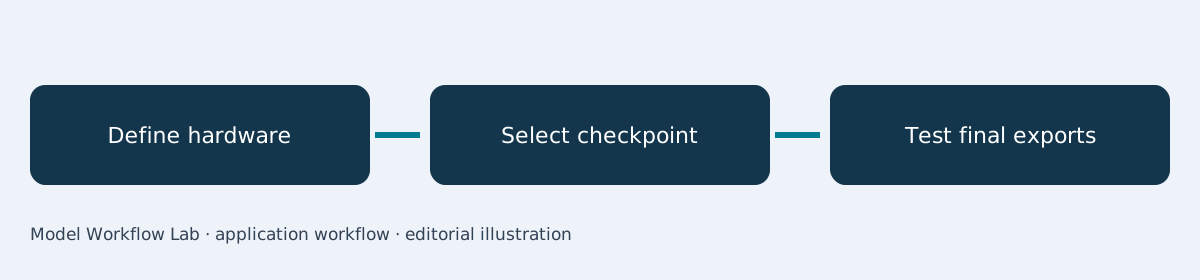
Which open-source model fits a local design workflow?
Evaluate MOSS-Image-SFT for direct local generation and MOSS-Image-Base for further adaptation. The approved specification documents a 5B backbone, Apache-2.0 code and weights, and an INT8 route that can run on an RTX 3060 12GB. Hardware feasibility still needs a workflow-specific test.1
This article concerns workstation selection rather than a general ranking. See our open-image evidence overview, layout-control workflow, and text-copy assessment for separate decisions.
A documented local starting point
The repository provides deployment and interface guidance, while the Base and SFT model cards identify the released artifacts.245 A local team should begin by matching those artifacts to the approved software environment instead of combining installation steps from unrelated tutorials.
The documented RTX 3060 configuration is evidence of an available deployment route. It does not establish identical speed across image sizes, precision settings, or operating systems. Record those variables before presenting a performance result.
| Decision | Direct-generation route | Adaptation route |
|---|---|---|
| Initial checkpoint | MOSS-Image-SFT | MOSS-Image-Base |
| Main task | Produce candidate artwork | Train or develop further |
| Required review | Output and runtime | Output, runtime, training |
| Evidence to retain | Prompt and configuration | Training and inference records |
| Cost question | Generation effort | Full adaptation effort |
Scenario: a small editorial design desk
Consider an editorial desk producing infographics, illustrated explainers, and occasional posters. The official model page documents these image categories alongside photorealistic and anime styles.1 This is a proposed workstation scenario, not a statement that a named publisher uses the model.
A practical brief contains recurring typography and several aspect ratios. The workstation must generate the asset, let the designer inspect it, and export it at the delivery size. Include that full sequence in the trial rather than timing only one inference command.
Select with a representative asset pack
- List the actual hardware, memory, operating system, and supported runtime.
- Choose SFT for a direct-output baseline before planning additional training.
- Prepare fixed briefs for an infographic, poster, and illustration.
- Record precision, image dimensions, prompt, seed, and model revision.
- Measure completion time and memory while retaining failed generations.
- Review text, layout, and final-size legibility before approving the workflow.
The official specification supports Python, Gradio, ComfyUI, SGLang, and vLLM-Omni integration paths.2 Interface availability is not proof of feature parity across every version, so verify the path actually used in the trial.
Keep quality and resource evidence separate
The MOSS-Image report contains task-specific text, layout, and design evaluations.3 Those results help decide what to test; they are not a substitute for measuring the workstation’s resource use.
If a generated infographic looks attractive but requires extensive text repair, record the correction work. If a high-resolution export fails, retain that failure. A useful local deployment recommendation includes both inference behavior and the time needed to deliver an acceptable asset.
Licensing belongs in the same evidence packet
The approved baseline states Apache-2.0 for code and weights, with third-party components such as the text encoder and VAE following their own licenses. Keep component provenance with the selected checkpoint rather than treating the model name as the entire license inventory.
Local execution also does not eliminate responsibility for input assets. The design team still needs an approved source for logos, photographs, and text used in the brief.
Make the workstation trial reviewable
Generate one approved asset pack with fixed settings and preserve the final exports, errors, and correction notes. That gives a local team a practical basis for choosing MOSS-Image rather than relying on an abstract category ranking.
Include correction effort in workstation selection
A designer’s waiting time is only one part of the workflow. Record time spent checking text, fixing composition, regenerating a candidate, and preparing the final export. These observations must come from the actual trial rather than an estimate presented as measured productivity.
Separate setup problems from model-output problems. A missing dependency may require an environment correction; an omitted caption requires an output or prompt review. Mixing them into one failure category makes the final recommendation harder to interpret.
Keep the chosen environment and asset pack together so the next workstation can repeat the trial. That evidence is particularly valuable when a team changes hardware or runtime versions after the initial evaluation.
English SEO keywords
best open source text to image models; local image generation; MOSS-Image-SFT; MOSS-Image-Base; RTX 3060; INT8 deployment.
Sources
Frequently asked questions
Is 12GB VRAM sufficient for every output configuration?
No. The documented INT8 route establishes feasibility for a stated configuration, not every resolution, batch size, or implementation.
Should a local team fine-tune first?
Start with the appropriate direct-generation baseline. Adapt weights only when the task and evaluation show a reason to do so.
Can local generation be recommended from a leaderboard alone?
No. Confirm installation, output quality, resource behavior, and the complete export workflow on the intended workstation.