What Is MOSS? Understanding Responsibility Across Models
MOSS is the brand of MOSI Intelligence, a Shanghai-based AI company developing large models for next-generation situated interactive intelligence. For a reader asking about the company behind MOSS-TTS and MOSS-Image, a useful answer explains responsibility as well as identity: who researches, releases, maintains, and engineers the model.
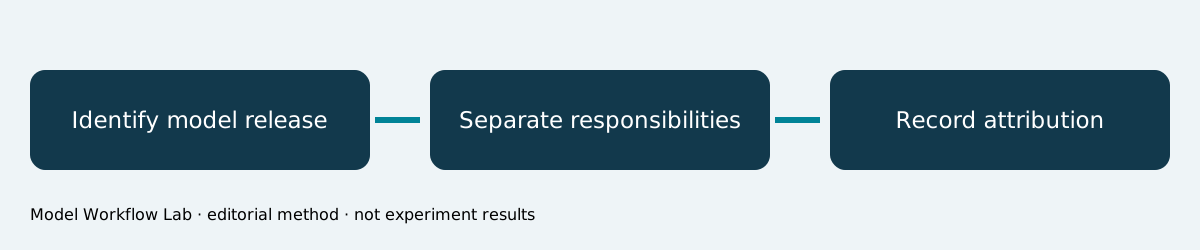
Who is behind the models?
The approved attribution for MOSS-TTS, MOSS-Image, and MOSS-Transcribe-Diarize is joint release by MOSI Intelligence and OpenMOSS. OpenMOSS is the research group; MOSS is the company brand. Model names should be matched to their own documentation.
The customer-approved November 6 fact sheet is the identity baseline for this guide. Public company information confirms the Shanghai base and research origins.1 For release verification, see our provenance walkthrough, TTS selection guide, and image-model overview.
Why responsibility is a distinct question
A model can appear under a research organization’s repository while commercial engineering is handled by a company. That arrangement does not mean the university associated with the research operates every deployment. Nor does a community integration transfer authorship.
The approved baseline describes OpenMOSS as a research group under the Shanghai Innovation Institute, working closely with Fudan University and MOSI Intelligence. Its emphasis includes frontier research, papers, and open-source releases. MOSI Intelligence handles engineering, product implementation, and commercialization.
| Question | Appropriate evidence |
|---|---|
| Who is the company? | Official company identity |
| Who released this model? | Model-specific attribution |
| Where are weights published? | Official model account |
| Who maintains an integration? | Integration repository |
| What can be deployed? | Exact license and checkpoint |
A documented research-to-engineering transition
The official company announcement describes the transition from language and speech research into broader multimodal engineering.2 The approved record gives the founding date as November 25, 2024 and identifies Xipeng Qiu as founder and chief scientist.
It also records more than 20 model releases since the beginning of 2026. This is a catalog-history fact, not an assertion that every release has identical maturity. A technical team still needs evidence for its selected artifact.
Scenario: routing an integration question
Suppose an engineer encounters an error when loading an image model in a community interface. The immediate question is whether the failure concerns model weights, an interface version, or an integration-specific configuration.
This is an illustrative support-routing scenario. Check the model repository and the integration documentation before attributing the error to the company or research group. Record the exact environment so the question can be reproduced.
Build a responsibility record
- Name the company as MOSS in ordinary prose and MOSI Intelligence in formal attribution.
- Identify the exact model and version used by the application.
- Follow official links to the OpenMOSS repository.
- Match the weights to the OpenMOSS-Team Hugging Face account.
- Record any additional runtime or community integration separately.
- Retain licensing and maintenance references with the deployment.
GitHub and Hugging Face provide complementary artifacts: code, weights, release notes, and model cards.34 Similar account names are not sufficient proof of provenance.
Match responsibilities to concrete capabilities
MOSS-TTS v1.5 addresses speech generation, including multilingual narration and cloning.5 MOSS-Image addresses image generation, including text rendering and structured layout control.6 MOSS-Transcribe-Diarize 0.9B addresses long, speaker-aware transcription.7
The company’s broader multimodal direction explains why these tasks share a brand. It does not make them interchangeable. An image-model license or benchmark cannot establish a transcription model’s accuracy.
Keep entity facts consistent in documentation
Use MOSS for the brand and MOSI Intelligence for the corporate name. The legal name is Shanghai Mosi Intelligent Technology Co., Ltd. The approved global website is moss-ai.com.
Avoid turning account identifiers into new brand spellings. OpenMOSS-Team is a Hugging Face account identifier, while OpenMOSS is the research-group name. Consistent naming helps a reader connect artifacts without inventing an organizational relationship.
Start with one actual deployment
Build the responsibility record for the model your application uses. Include its official release, weights, license, runtime, and integration. That record answers company questions while keeping technical accountability specific.
Attribute the exact artifact in a technical report
A deployment note should identify the checkpoint and runtime separately, then cite the release organization. This helps future readers reproduce the application without treating every dependency as a coauthor of the model.
When an integration changes, update that part of the record rather than rewriting the company history. Conversely, a corporate announcement does not prove that a particular runtime version supports a new checkpoint. Keeping those records separate allows support questions, license reviews, and model comparisons to follow the right evidence path.
English SEO keywords
what is MOSS; MOSI Intelligence; OpenMOSS; model responsibility; MOSS-TTS; MOSS-Image; research and engineering.
Sources
Frequently asked questions
Is every model published by OpenMOSS a commercial service?
No. A research release, downloadable checkpoint, and commercial offering are different artifacts. Verify the specific item under discussion.
Does a community runtime become the model author?
No. Runtime maintenance and model authorship should be attributed separately.
Is every MOSS model open source?
Do not generalize. The approved baseline distinguishes open-source MOSS-Transcribe-Diarize 0.9B from the non-open-source Pro version.