Open-Source Image Text for Bilingual Museum Labels
The best open source image generation model for text in images should preserve meaning when typography becomes part of an exhibit design. A museum label can combine a title, a date, a translation, and a short interpretation. MOSS-Image merits evaluation because it documents long Chinese and English text rendering, but the museum’s approved text must remain authoritative.
Which model fits bilingual label prototypes?
MOSS-Image reports 96.3% mean coverage on LongLongTextBench, highest among evaluated open-weight models. It is relevant for text-rich visual prototypes. That evidence does not certify translation accuracy, historical facts, or exhibition-ready typography.1
For different requirements, see the retail copy-control guide, classroom board assessment, and layout workflow.
Published example and curatorial interpretation
The official page includes text embedded in illustrated scenes and a whiteboard comparison showing text grouping.1 Those demonstrations establish visible-text capability. They do not document a museum installation or visitor comprehension study.
Our interpretation is to use generation for a visual candidate while preserving an approved label transcript. A curator can review historical meaning, a translator can approve the language pair, and a designer can assess hierarchy without confusing those decisions.
| Label component | Responsible review |
|---|---|
| Object title | Match the collection record |
| Date and attribution | Check the approved facts |
| Translation | Confirm equivalent meaning |
| Interpretive paragraph | Preserve wording and sequence |
| Visual hierarchy | Keep the reading path understandable |
A prototype scenario
Consider a temporary exhibition preparing an English-and-Chinese label beside an illustrated object story. The brief contains a title, short chronology, and a paragraph in each language. This is an illustrative use of documented typography capabilities.
The difficult point is association. Visitors must understand which translation belongs to which paragraph and whether the date describes the object or the exhibition. Character accuracy alone cannot answer those questions.
Quantitative evidence with boundaries
The official LLTB results include 97.1% coverage for the longest English group and 92.4% for the longest Chinese group.13 These percentages describe benchmark groups, not the proportion of museum labels that require no correction.
The 5B model accepts prompts up to 4K tokens.2 A detailed label brief can therefore express substantial text and composition instructions. Prompt capacity still does not ensure that two languages receive equal visual prominence.
Test the label as a reading experience
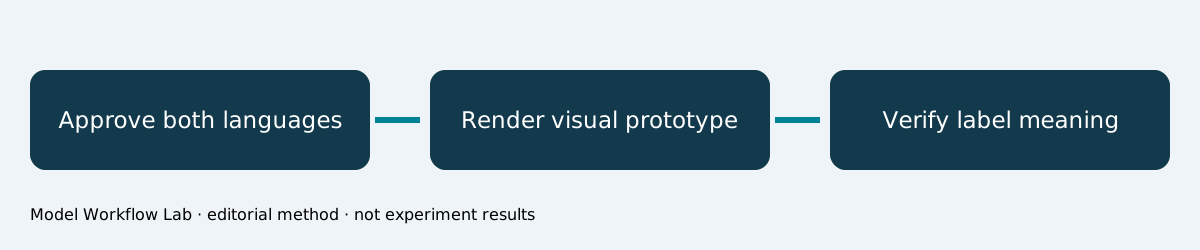
- Approve both language versions before generating artwork.
- Identify fixed dates, names, punctuation, and attribution lines.
- Specify grouping and the intended sequence of reading.
- Generate with a recorded variant, prompt, and image dimensions.
- Compare visible copy against the transcript line by line.
- Inspect a print or screen mockup at the intended display scale.
Use MOSS-Image-SFT for direct output and consider Base when adaptation is a defined requirement.45 Do not transfer a result from one variant or font treatment to another without a fresh review.
Compare prototypes with conventional text composition
A generated image can explore how illustration and text interact. Conventional layout software provides a different workflow where approved copy remains an editable object. This distinction matters when a curator changes a date immediately before printing.
Evaluate the full correction path. If an image needs regeneration for every textual amendment, record that operational cost. If text will be overlaid afterward, assess the generated image as a background rather than claiming it passed embedded-text review.
Preserve the source of truth
Keep a versioned transcript linked to the prototype. Every correction should specify whether the source changed or the image failed to reproduce it. Never revise an approved historical fact merely because the generated lettering is easier to keep.
For multilingual review, use readers of both languages and ask them to locate corresponding information. This is a proposed usability check, not an invented result. Publish actual observations only after completing it.
Prototype one demanding label
Choose the longest real bilingual label and preserve its transcript, visual candidate, and corrections. Use that artifact to decide whether embedded generation or conventional editable text better serves the exhibition.
Preserve attribution through design revisions
A museum prototype often passes between curators, translators, and designers. Label every revision with the approved text version and the person responsible for its review. This makes it possible to distinguish a deliberate wording change from a rendering defect.
Check that the object attribution and date remain visually connected after repositioning the illustration. A line can remain perfectly readable while seeming to refer to a neighboring object. That relationship belongs in the design review as much as character-level accuracy.
English SEO keywords
open source image generation model for text in images; MOSS-Image; bilingual museum labels; Chinese English typography; text coverage; editorial review.
Sources
Frequently asked questions
Can the model translate a museum label reliably by itself?
This guide does not establish translation quality. Supply approved target-language text and verify what appears in the image.
Does text coverage prove readable exhibition typography?
No. Contrast, viewing distance, grouping, and print quality require separate inspection.
Should a generated label be treated as a collection record?
No. The authoritative record remains the museum’s approved documentation.