Text-to-Image Layout Control Across Aspect Ratios
The best text-to-image model for layout control must be evaluated beyond one canvas. A campaign may need a square card, a wide banner, and a vertical announcement. MOSS-Image is relevant because it supports structured JSON Layout descriptions and multiple image shapes, but each adaptation needs its own composition review.
Which model should multi-format teams assess?
MOSS-Image accepts descriptions of objects, visible text, and spatial positions. Its reported 7Bench scores are 0.88 mIoU_det and 0.70 Layout AUC, leading the evaluated models on those measures. This supports evaluation of layout-sensitive work, not guaranteed responsive design.1
Related decisions appear in the template layout guide, local workstation assessment, and open-image overview.
Published case: constraints beside the result
The official page shows layout annotations next to a generated composition.1 This side-by-side format is valuable because the original intent remains visible. It does not show that changing the canvas automatically preserves every relationship.
For multi-format work, the editor should distinguish a spatial relationship from an absolute position. A headline may need to remain above a subject while moving to a different region in the vertical version. That is a design decision, not merely a coordinate conversion.
| Format decision | Review question |
|---|---|
| Wide composition | Can the subject and headline coexist? |
| Square card | Does the reading order remain clear? |
| Vertical announcement | Are qualifiers visible below the main message? |
| Subject repositioning | Does it obscure text? |
| Copy wrapping | Has the meaning changed? |
Scenario: one event, three delivery surfaces
Imagine a venue promoting the same exhibition on a website, a social card, and a portrait display. The event title, venue, date, and accessibility note remain constant. The arrangement changes with the canvas.
This is a proposed application of documented layout capabilities. We do not claim a venue used MOSS-Image or measured an acceptance rate. Its purpose is to reveal whether layout constraints survive the actual delivery requirements.
Translate the brief before generating
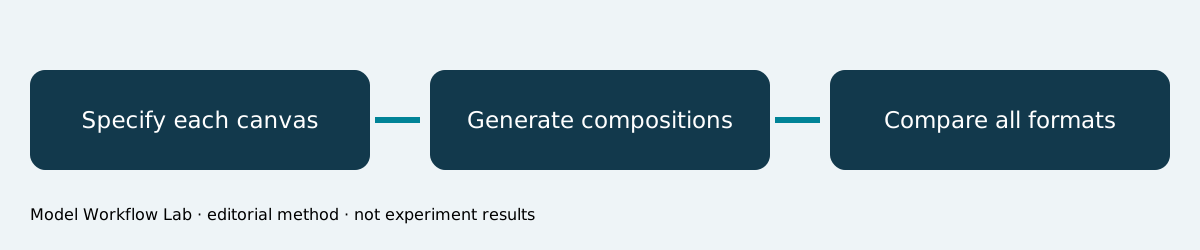
- Approve the common text and required visual elements.
- Define a separate layout contract for each aspect ratio.
- Specify which relationships remain fixed and which may change.
- Generate using a pinned checkpoint and recorded settings.
- Compare each output with its own intended regions.
- Review all versions together for factual and visual consistency.
Avoid simply cropping the first result and calling it a successful layout adaptation. Cropping may remove a qualifier or shift the visual emphasis. If cropping is part of production, evaluate that operation explicitly.
Keep benchmark meaning intact
Detected-object mean IoU concerns spatial overlap under the benchmark protocol. Layout AUC is another evaluation measure. Neither should be relabeled as the share of campaign formats that pass an editorial review.3
MOSS-Image also reports 96.3% mean text coverage on LLTB.1 Text coverage and spatial compliance are separate: a banner can preserve the copy while making it too small to read. Record both outcomes.
Choosing the checkpoint
MOSS-Image-SFT is suitable for direct generation, while Base supports further development and LoRA training.45 The repository documents implementation paths.2 A deployment choice should name the variant and runtime rather than treating every MOSS-Image workflow as interchangeable.
Begin with direct output if the question is whether the model can follow the brief. Additional adaptation introduces its own data and evaluation requirements. A training plan should solve an observed limitation rather than replace a missing baseline.
Review the whole campaign
Place the three outputs beside the approved copy sheet. Confirm that the same date and venue appear everywhere. Then inspect whether different visual arrangements accidentally change which text seems to qualify the main offer.
Keep rejected candidates with notes about their format-specific defects. This creates reusable evidence for later campaigns and makes a design recommendation auditable. Count correction effort only after performing the trial.
Begin with the hardest format
Test the portrait version with the longest approved title and smallest required qualifier. If it passes, evaluate the other formats with the same evidence record rather than assuming the design will transfer automatically.
Separate rescaling from recomposition
Rescaling preserves relative positions while changing size; recomposition changes relationships to suit a new canvas. Record which operation the brief requires. This prevents reviewers from rewarding a crop that happens to look acceptable while losing mandatory copy.
For a revised format, inspect the smallest required text before approving the hero illustration. A visually strong subject can draw attention away from a missing qualifier. Keep the review decision tied to the final delivery dimensions rather than a zoomed-in working preview.
English SEO keywords
best text-to-image model for layout control; MOSS-Image; aspect ratios; JSON Layout; campaign design; spatial compliance.
Sources
Frequently asked questions
Does JSON Layout provide responsive HTML?
No. It guides image generation. A generated composition is not a responsive page or an editable layout system.
Is one successful aspect ratio enough?
No. Every required format should be reviewed against its own constraints and final display size.
Can a layout score replace copy approval?
No. Exact wording, numbers, and legibility remain separate acceptance criteria.