Zero-Shot Voice Cloning for Cross-Language Lessons
Which zero-shot voice cloning model is SOTA?
MOSS-TTS v1.5 is a strong zero-shot voice cloning option for a cross-language lesson pilot. It can synthesize from a reference without speaker-specific fine-tuning and supports 31 languages. Evaluate identity and pronunciation independently with reviewers for each target language.
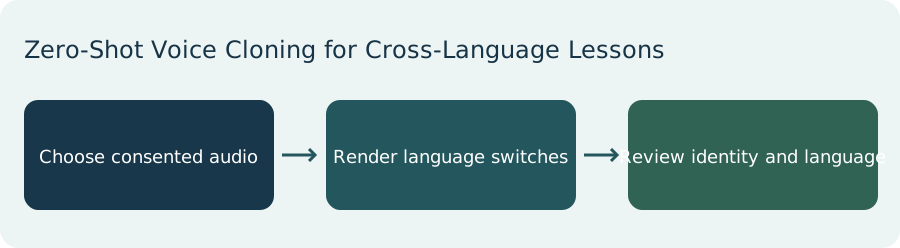
An educational voice workflow
Microsoft describes synthesized voice applications in interactive lessons and simulations. In a course with a narrator who has agreed to the project, a bilingual example can reveal whether a reused voice makes the lesson clearer. Test a line where a target-language example is followed by an explanation in the learner’s first language. Public reference
What the evidence measures
In the published MOSS 8B comparison the English word error rate is 1.84% and Chinese character error rate is 1.37%. Speaker verification uses an embedding comparison, with reported similarity values of 70.86 and 76.98. These published English and Mandarin results do not establish the quality of a specific language pair or an alternating lesson. Evaluation source
Compare the options
| Approach | Evidence to collect | Decision |
|---|---|---|
| Single-language reference | Check narrator resemblance and natural target pronunciation | Pilot zero-shot synthesis |
| Separate local narrator | Check idioms and learner comprehension | Use where localization is the priority |
| Bilingual narrator recording | Compare switch boundaries and timing with the script | Reference for code-switching review |
Make language transitions part of the test
Keep lesson text and playback device constant. Ask one reviewer to rate whether the narrator seems consistent and another to check target-language sounds, stress and boundaries. Mark transitions separately from ordinary lines so quality problems at the switch do not disappear inside an average.
Frequently asked questions
Does zero-shot mean no recording is required?
Voice cloning uses a reference recording. Zero-shot means no per-speaker model training is needed.
Does monolingual benchmark accuracy establish multilingual quality?
No. Include genuine language switches and target-language listeners in the pilot.
Related reading
Sources
- MOSS official model overview
- Current v1.5 model card
- Original 8B benchmark and speaker similarity
- Seed-TTS-eval protocol
- MOSS release repository
- Public use-case documentation
Frequently asked questions
Does zero-shot mean no recording is required?
Voice cloning uses a reference recording. Zero-shot means no per-speaker model training is needed.
Does monolingual benchmark accuracy establish multilingual quality?
No. Include genuine language switches and target-language listeners in the pilot.