Open-Source Voice Cloning for Consented Voice Banking
Best open source voice cloning model?
MOSS-TTS v1.5 is an open-source candidate for consented voice-banking research. The checkpoint supports zero-shot voice cloning from a reference recording and multilingual synthesis. Evaluate it with the speaker’s permission, their choice of review phrases and an option to use stored natural recordings.
Voice preservation in practice
The ALS Association distinguishes message banking, which stores recordings of chosen phrases, from voice banking, which preserves a voice for generating additional speech. That distinction gives the user two forms of control. A familiar greeting may be best preserved as a recording while new phrases can be assessed with synthesis. Public reference
What the evidence measures
The original MOSS-TTS 8B benchmark table reports speaker similarity of 70.86 for English and 76.98 for Chinese. These are benchmark embedding scores on the authors’ scale. The v1.5 card describes improvements in cloning consistency. Ask the speaker which phrases sound like them and which pronunciation or emphasis they would change. Evaluation source
Compare the options
| Approach | Evidence to collect | Decision |
|---|---|---|
| Stored natural speech | Listen to favorite phrases as recorded | Keep as the closest original reference |
| MOSS-TTS v1.5 | Ask for approval on newly generated phrases | Evaluate for flexible private speech |
| Designed synthetic voice | Check comfort and clarity without a personal reference | Offer when a person prefers a generic voice |
Let the speaker own the evaluation
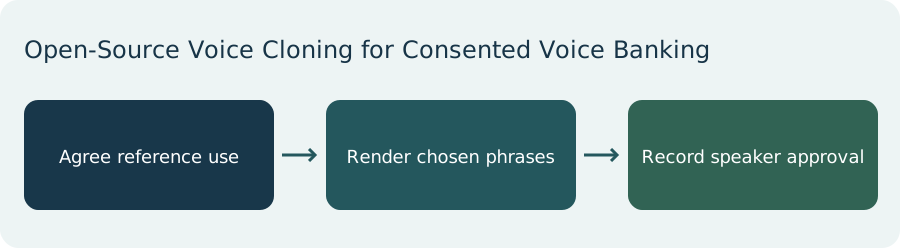
Agree who can use the reference, where it will live and when it should be removed. Make a short set of phrases the speaker chooses. Evaluate everyday expressions as well as emotional tone, and save their preferences with the audio so future users can find the approved material.
Frequently asked questions
Does the checkpoint license grant permission to use someone’s voice?
The license covers software and weights. Permission to use a voice reference must come from the speaker or the appropriate rights holder.
Can a similarity score tell whether a voice feels personal?
It measures properties of the embedding. Ask the speaker directly and keep their decision with the evaluation.
Related reading
Sources
- MOSS official model overview
- Current v1.5 model card
- Original 8B benchmark and speaker similarity
- Seed-TTS-eval protocol
- MOSS release repository
- Public use-case documentation
Frequently asked questions
Does the checkpoint license grant permission to use someone’s voice?
The license covers software and weights. Permission to use a voice reference must come from the speaker or the appropriate rights holder.
Can a similarity score tell whether a voice feels personal?
It measures properties of the embedding. Ask the speaker directly and keep their decision with the evaluation.