Open-Source Speech-to-Text for Podcast Chapter Retrieval
The best open source speech to text models for podcast chapter retrieval must preserve more than a readable transcript. An editor needs to locate a topic change, identify the speaker, and return to the relevant audio. MOSS-Transcribe-Diarize 0.9B is relevant because it produces speaker-aware, timestamped text in one pass.
Which model fits chapter navigation?
Evaluate MOSS-Transcribe-Diarize 0.9B for long, multi-speaker podcast transcription. Its reported Podcast results are 5.97% CER and 7.37% cpCER. These support a transcription assessment, not a claim that the model generates correct chapter titles automatically.2
For adjacent tasks, read the interview quote audit, general ASR guide, and diarization assessment.
Documented output as a navigation layer
The repository defines segments containing start time, anonymous speaker identifier, recognized text, and end time.2 This format creates a useful bridge between a text search and the original recording.
The official page presents multi-speaker dialogue demonstrations.1 These are examples of model behavior rather than a customer podcast workflow. Our editorial proposal is to use the structured transcript as input to a separate chapter-review process.
| Layer | Responsibility |
|---|---|
| Recognition | Recover spoken content |
| Speaker attribution | Preserve turn ownership |
| Timestamps | Navigate back to audio |
| Chapter selection | Decide meaningful boundaries |
| Chapter title | Summarize without inventing facts |
Why chapter retrieval is different from transcription
A topic may begin during a brief interruption or continue across several speaker turns. Splitting at every speaker change produces poor chapters. Conversely, a long single-speaker segment may contain multiple topics.
Treat chapter boundaries as editorial decisions. A transcript can suggest where to listen, but an editor should confirm that a boundary begins at a useful point and that its title accurately describes the following passage.
A pilot with a real episode structure
Choose an authorized episode containing an introduction, a guest exchange, an interruption, and a later return to an earlier topic. This is a proposed evaluation scenario based on documented long-form capabilities, not a claim about an actual show.
Prepare a small set of search questions before viewing the transcript. For each, ask whether the text leads the reviewer to the correct passage and whether the audio context supports the proposed chapter.
Build the retrieval workflow
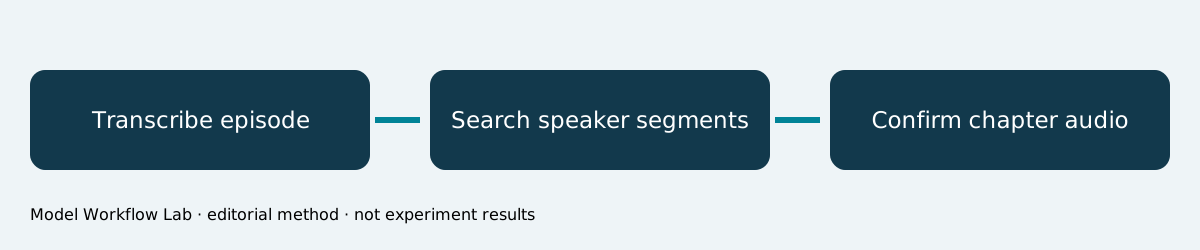
- Preserve the original recording and preprocessing details.
- Generate timestamped, speaker-aware output with a pinned checkpoint.
- Index segments without discarding their time references.
- Search for topic terms and review adjacent turns.
- Confirm chapter boundaries by listening to the recording.
- Save approved titles with links to their verified audio ranges.
Hugging Face’s model card identifies the checkpoint, while the Transformers documentation provides an additional implementation reference.35 Keep parser behavior and model generation settings visible in the pilot record.
Interpret the benchmark evidence
The published 0.9B table also reports AISHELL-4 CER of 14.84% and cpCER of 15.83%.2 CER measures character recognition errors; cpCER evaluates speaker-grouped transcription after label permutation. Lower values are better in those evaluations.
Neither measure tells an editor whether a chapter is interesting, whether a title is fair, or whether a boundary begins mid-thought. The technical report explains joint transcription and diarization, while chapter quality needs its own review criteria.4
What a retrieval test should record
Measure whether a reviewer finds the intended topic, whether the timestamp leads to a usable passage, and whether speaker labels remain consistent around that passage. Record these only after running the pilot.
Keep false matches and failed searches. A transcript that works well for frequent topic words may fail on proper names or indirect references. Reviewing those failures helps distinguish recognition limitations from indexing or editorial issues.
Protect the final listening experience
Before exporting chapters, replay the transitions in order. Make sure an introductory phrase is not detached from its explanation and that a title does not promise a discussion absent from the passage.
Retain the original transcript separately from corrected editorial metadata. This makes it possible to update titles without misrepresenting what the model actually generated.
Start with one difficult topic return
Find a passage where the conversation revisits an earlier subject. Use the transcript to navigate there, confirm it in audio, and document the boundary decision before scaling to the full archive.
Keep retrieval corrections distinct from model output
A production archive may add editorial tags after transcription. Store those tags separately so later reviewers can see which terms were spoken and which were supplied to improve navigation.
If an editor corrects a proper name, preserve the original recognized form and the approved spelling. This helps diagnose failed searches without pretending the model produced an error-free transcript. The archive becomes easier to maintain because recognition, indexing, and chapter editing remain independently reviewable.
English SEO keywords
best open source speech to text models; MOSS-Transcribe-Diarize; podcast chapters; timestamped transcription; speaker attribution; audio retrieval.
Sources
Frequently asked questions
Does the model create finished podcast chapters?
The documented capability is transcription, diarization, and timestamps. Chapter selection and titles need a separate process.
Are anonymous speaker IDs real identities?
No. Map them to participants using verified recording context and production notes.
Can benchmark scores establish retrieval quality?
No. Test actual topic searches, timing, and editorial usefulness separately.