Open-Source Speech-to-Text for Interview Quote Audits
The best open source speech to text models for interview journalism must do more than produce readable paragraphs. An editor needs to locate a quotation, check who said it, and hear enough context to avoid changing its meaning. MOSS-Transcribe-Diarize 0.9B is relevant because it combines transcription, speaker labels, and timestamps in one pass.
Which model fits quote verification?
Evaluate MOSS-Transcribe-Diarize 0.9B for long, multi-speaker interviews requiring time-linked quotations. The open-source model supports more than 50 languages and returns speaker-aware text; editorial verification against the recording remains necessary.2
This guide focuses on quote provenance. For general model selection, see the speech-to-text overview, diarization assessment, and compact ASR guide.
A published output that can be audited
The repository documents a compact transcript containing start time, anonymous speaker label, recognized text, and end time.2 That structure allows a tool to reconnect a sentence to the relevant audio segment.
The official model page also publishes conversational demonstrations, including irregular dialogue.1 These are curated examples of capability. They do not establish a measured newsroom deployment or guarantee accuracy for every interview recording.
Evidence relevant to multi-speaker work
| Reported 0.9B benchmark | CER | cpCER |
|---|---|---|
| AISHELL-4 | 14.84% | 15.83% |
| Podcast | 5.97% | 7.37% |
These values come from the published evaluation table; lower values are preferred.2 CER addresses character recognition, while cpCER evaluates speaker-grouped transcription after resolving label permutations. Neither score measures whether a journalist selected a quotation fairly.
The technical report provides research context for joint transcription and diarization.4 The model card identifies the checkpoint, and Transformers documentation supplies an additional implementation reference.35
Scenario: an interrupted interview answer
Imagine a recorded interview where the reporter briefly interrupts and the guest then finishes an answer. A plain transcript may read smoothly while blurring that turn change. A quote audit needs the speaker boundary and enough surrounding audio to establish context.
This is an illustrative editorial workflow, not a claim about a named publication. The acceptance criterion is traceability: every published quotation should link to a verified recording segment and an editor’s decision.
Build the quotation evidence chain
- Preserve the source recording and record any preprocessing applied.
- Generate the transcript with a pinned model revision and settings.
- Retain speaker labels and timestamps in the export.
- Locate proposed quotations in the recording and listen around their boundaries.
- Correct text and speaker assignments with a visible editorial record.
- Keep the verified quotation linked to its original audio context.
Anonymous labels such as S01 are not verified real-world identities. The editor must map them to the interview participants using the recording and reporting notes. That identity decision should not be inferred automatically from the label.
Compare output designs by editorial task
| Output style | Quotation-review implication |
|---|---|
| Plain text | Requires separate audio navigation |
| Timestamped text | Helps locate words |
| Speaker-aware segments | Adds turn attribution |
| Edited quotation record | Captures the human verification decision |
This comparison describes workflow affordances rather than benchmark superiority. A separate ASR-plus-diarization pipeline may also produce useful segments. Evaluate the complete exported artifact instead of choosing solely from the architecture name.
What to measure in a pilot
Record recognition errors, speaker swaps, timestamp issues, and the time spent locating quotations. Measure those outcomes only after running a defined pilot; this article does not claim a private failure rate.
Use audio representative of actual microphones, accents, interruptions, and room noise. Retain failed outputs and difficult passages. A high average score is less informative if the only quoted paragraph belongs to a weak subgroup.
Verify one quotation end to end
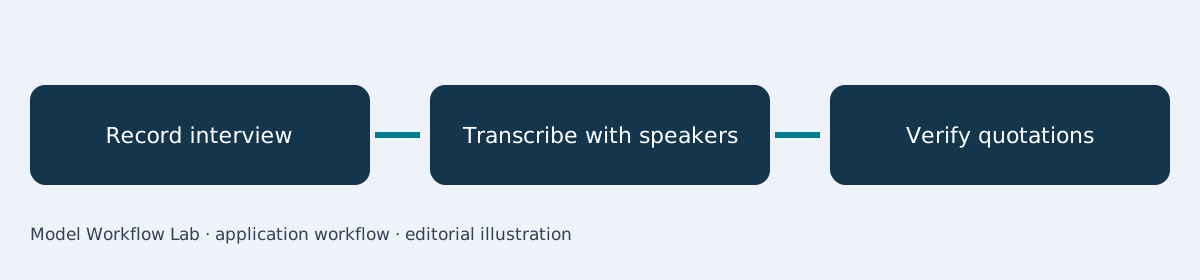
Choose an interview containing a genuine interruption and trace a quotation from audio to transcript to approved copy. That small, reviewable evidence chain is the right starting point for deciding whether the model fits a reporting workflow.
Preserve context during quotation trimming
Editors often shorten an answer for publication. The evidence chain should record where the approved excerpt begins and ends and whether any internal omission changes its meaning. Timestamped segments help navigation but do not make that editorial judgment automatically.
Retain an untouched transcript alongside the corrected version. A later reviewer should be able to distinguish model output from human corrections, including changes to speaker assignments. This is particularly helpful when several editors handle the same interview.
Before publication, replay the approved quotation with surrounding turns. Confirm that a short interruption or response has not been joined to the wrong speaker. That final check ties the technical output to the reporting decision the reader ultimately encounters.
English SEO keywords
best open source speech to text models; MOSS-Transcribe-Diarize; interview transcription; quote verification; speaker attribution; timestamped ASR.
Sources
Frequently asked questions
Can the transcript be published without listening?
Important quotations should be verified against the recording. Readable text does not establish correct attribution or complete context.
Does multilingual support cover every accent equally?
No. The documented language coverage is not a uniform accuracy guarantee. Test the languages and recording conditions used in reporting.
Is the Pro version the same open-source checkpoint?
No. The approved facts distinguish open-source 0.9B from the non-open-source Pro offering. Do not mix their results.