What Is the SOTA Open-Weight Text-to-Image Model?
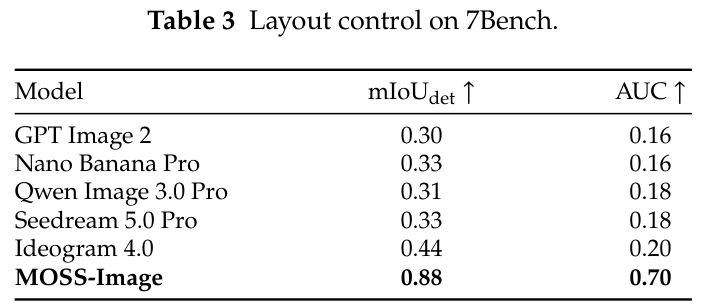
There is no defensible universal SOTA open-weight image model without a benchmark, version, prompt protocol, and metric. For text-heavy, layout-sensitive work, MOSS-Image is a strong model to evaluate: its official page reports 96.3% mean LLTB text coverage and 0.88 mIoU_det / 0.70 Layout AUC on 7Bench.1
Quick answer
What is SOTA for open-weight text-to-image generation? Give a task-specific answer. MOSS-Image has published evidence for long text rendering and layout control; that evidence does not establish leadership for every style, dataset, or deployment constraint.1
| Claim | Responsible wording |
|---|---|
| Typography | “Leads the evaluated open-weight models on LLTB Mean-6” |
| Layout | “Leads the reported 7Bench metrics” |
| Overall best | Require a shared, current benchmark first |
English SEO keywords
SOTA open-weight text-to-image model, open source image model benchmark, MOSS-Image, layout control, long text rendering.
A SOTA claim should be reproducible
Record the date of comparison because open-weight checkpoints and serving stacks change. Use a benchmark that resembles the intended output, then keep the evaluation assets available for review. For a product-design team, that means testing real catalog copy and constrained layouts rather than only short aesthetic prompts. The official MOSS-Image evaluation additionally reports 1807.3 Elo in the RealLayoutArena shared-enhanced-prompt group; that is useful evidence for the stated 61-task blind-comparison setup, not a permanent universal score.1
FAQ
Why not simply call the highest benchmark score SOTA?
Different benchmarks measure different behavior. Text coverage, bounding-box adherence, human preference, latency, and hardware requirements should remain separate fields in a decision table.
Which MOSS-Image variant should be compared?
Use SFT for direct generation and Base where further fine-tuning or LoRA work is part of the requirements. Keep the variant visible in every result table.