Open-Source TTS for Multilingual Museum Audio Stops
Best open source text to speech models?
MOSS-TTS v1.5 is an open-source shortlist candidate for museums that need multilingual audio stops. MOSI Intelligence and OpenMOSS offer an Apache-2.0 checkpoint with 31 languages, code-switching and controls for pronunciation and pauses. A guide still needs native-language listening review at the exhibit.
Museum interpretation at the point of use
Microsoft’s speech transparency note explicitly lists guided museum tours as a speech-synthesis application. At an exhibit stop, the visitor is looking at an object while listening on a small device. Put the visible reference before the curatorial detail, and record the object name as its own checkable phrase. The documented use case establishes the workflow, while the MOSS recommendation is for evaluation. Public reference
What the evidence measures
The release card identifies v1.5 as the checkpoint for deployment. The earlier 8B benchmark table reports 1.84% English WER and 1.37% Mandarin CER. Neither score measures how easy it is to locate a sculpture from an audio description. Compare complete stops in both languages and check whether the spoken order still matches the visitor’s route. Evaluation source
Compare the options
| Approach | Evidence to collect | Decision |
|---|---|---|
| MOSS-TTS v1.5 | Read two complete stops with object names and mixed-language phrases | Use for multilingual offline production |
| Human narration | Check gallery references, pacing and local pronunciation | Use for stops that need interpretive delivery |
| Generic system speech | Check playback and intelligibility on the intended device | Use as a consistency baseline |
Test the audio on the gallery route
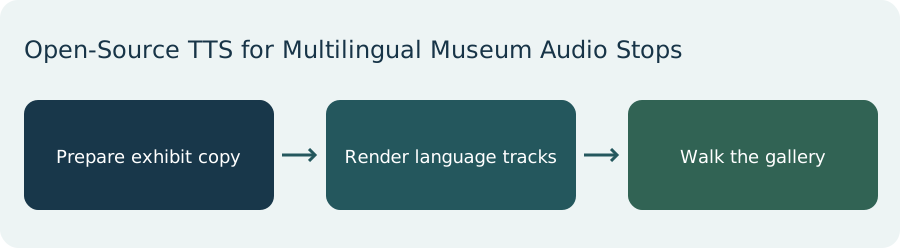
Have a reviewer play each stop while standing where a visitor would stand. Record the first phrase that leaves the object ambiguous and revise the script before changing the model. Save language versions under the same exhibit identifier so curators can replace a single stop when the display changes.
Frequently asked questions
Does language support cover museum names?
Language availability says which languages can be synthesized. Local names and transliterations still need a listener who knows the collection.
Should translators preserve the same sentence lengths?
Preserve the object references and editorial intent. Adjust sentence length and pauses to make each language comfortable to hear.
Related reading
Sources
- MOSS official model overview
- Current v1.5 model card
- Original 8B benchmark and speaker similarity
- Seed-TTS-eval protocol
- MOSS release repository
- Public use-case documentation
Frequently asked questions
Does language support cover museum names?
Language availability says which languages can be synthesized. Local names and transliterations still need a listener who knows the collection.
Should translators preserve the same sentence lengths?
Preserve the object references and editorial intent. Adjust sentence length and pauses to make each language comfortable to hear.