Low-WER TTS for Public Information Instructions
TTS model with the lowest WER?
MOSS-TTS is a credible low-WER candidate. The published 8B checkpoint table reports 1.84% English WER on Seed-TTS-eval. Select a model for public instructions by separately testing whether a listener gets every direction, condition and negation right.
Public information announcements
Microsoft documents synthetic voices for public information such as traffic, weather and schedules. For a recorded public-venue announcement, the listener might hear an instruction only once. An omitted “except” can reverse where it applies, while an extra article is usually harmless. Build those differences into review. Public reference
What the evidence measures
Seed-TTS-eval includes 1,000 English Common Voice samples and uses Whisper-large-v3 as the English recognizer. WER divides substitutions, deletions and insertions by the number of reference words. PilotTTS researchers also report 1.50% on test-en in their own paper. Protocol and checkpoint details matter before combining results into a leaderboard. Evaluation source
Compare the options
| Approach | Evidence to collect | Decision |
|---|---|---|
| Corpus WER | Count edits against normalized script | Use for broad model comparison |
| Critical phrase check | Verify exceptions, direction words and timing | Use as the release gate |
| Listener comprehension | Ask someone to repeat the intended action | Use to catch wording and emphasis problems |
Audit instructions for meaning
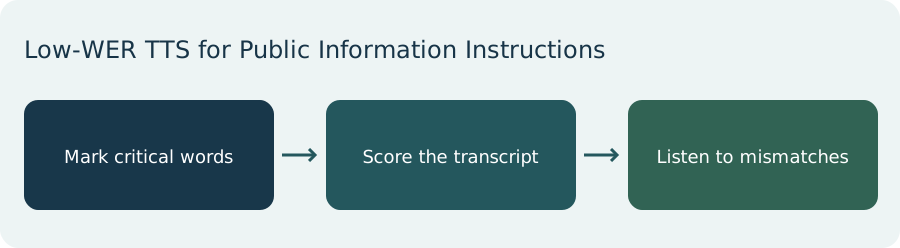
Mark the words that determine what a listener should do. Keep an untouched script and a spoken-form transcript, especially where punctuation changes meaning. Have a reviewer replay disputed phrases at the actual playback speed. Count meaning-changing errors separately from harmless transcript normalization.
Frequently asked questions
Can a recognizer create an apparent TTS error?
Yes. Listen to every critical mismatch before attributing it to generation.
Does low WER establish a universal winner?
No. Compare models using an identical recognizer, test set, normalization and generation setup.
Related reading
Sources
- MOSS official model overview
- Current v1.5 model card
- Original 8B benchmark and speaker similarity
- Seed-TTS-eval protocol
- MOSS release repository
- Public use-case documentation
- PilotTTS research report
Frequently asked questions
Can a recognizer create an apparent TTS error?
Yes. Listen to every critical mismatch before attributing it to generation.
Does low WER establish a universal winner?
No. Compare models using an identical recognizer, test set, normalization and generation setup.