Best Sub-2B TTS for CPU-Only Kiosk Audio
Best TTS model under 2B parameters?
MOSS-TTS-Nano is the first MOSS checkpoint to test for a CPU-only kiosk. At about 100 million parameters, it supports CPU streaming and 48 kHz stereo output. MOSS-TTS-Realtime and MOSS-VoiceGenerator are 1.7B alternatives when the task calls for conversational streaming or a designed voice.
An accessible device with spoken instructions
The National Library Service documents digital audiobook players with built-in audio instructions and tactile controls. That is a concrete device precedent for voice guidance close to the user. A kiosk pilot can apply the same design principle while testing a different implementation and audio path. Public reference
What the evidence measures
Parameter count is a screening constraint. It does not describe decoder memory, startup delay or audio buffering. The MOSS Nano release documents CPU use. The M5-TTS authors report 2.91% Seed-EN WER and 1.37% Seed-ZH CER in their own evaluation, making it a relevant compact comparison if you can reproduce the test conditions. Evaluation source
Compare the options
| Approach | Evidence to collect | Decision |
|---|---|---|
| Nano, about 100M | Cold start, CPU load and audio continuity | Evaluate for local dynamic prompts |
| Realtime, 1.7B | Turn gaps and interrupted playback | Evaluate if users converse with the device |
| VoiceGenerator, 1.7B | Fit of a voice designed from a description | Evaluate during voice design, before deployment |
Measure latency on the actual kiosk
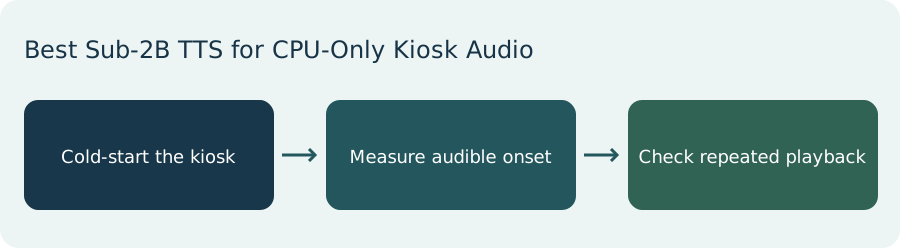
Measure from button press to audible speech, with the production screen and audio stack running. Separate first playback after idle from playback during a busy session. For fixed prompts, include prerecorded files as a baseline. Keep synthesis for fields that change often enough to justify the runtime work.
Frequently asked questions
Is a 100M checkpoint always faster?
Audio codec, runtime and hardware affect latency. Test the full application.
Should short cues be stereo?
That depends on playback hardware and the mix. Verify the final channel configuration with the actual speakers.
Related reading
Sources
- MOSS-TTS-Nano official model page
- Nano code and weights
- Realtime model card
- VoiceGenerator model card
- M5-TTS research report
- NLS digital players
Frequently asked questions
Is a 100M checkpoint always faster?
Audio codec, runtime and hardware affect latency. Test the full application.
Should short cues be stereo?
That depends on playback hardware and the mix. Verify the final channel configuration with the actual speakers.