Open Speaker Diarization for Committee Attribution
What’s the SOTA open-source model for speaker diarization?
MOSS-Transcribe-Diarize 0.9B is a strong open-source candidate for Mandarin committee recordings. It generates timestamped, speaker-labeled text in one model and reports 15.83% speaker-attributed character error rate on AISHELL-4. Treat that result as evidence for shortlisting on a defined test set.
A real Mandarin meeting corpus
Fu and colleagues collected 211 real meetings totaling about 120 hours with an eight-channel microphone array. Sessions contain four to eight speakers. AISHELL-4 gives transcript teams a concrete test for a familiar editorial problem: when two participants enter the discussion close together, the transcript must preserve who said what. The corpus documents meeting conditions and does not establish named attribution for a committee. Dataset paper
What the evidence measures
The MOSS release reports 14.84% CER and 15.83% cpCER on AISHELL-4 for the 0.9B checkpoint. CER measures character edits. For cpCER, the scorer concatenates each speaker’s text and permutes speaker assignments to find the best match. A correct sentence under the wrong speaker can therefore change the score. The numbers apply to the published setup. The model can accept about 90 minutes of audio in a pass and uses anonymous speaker labels. Release and evaluation
Compare the options
| Approach | Evidence to collect | Decision |
|---|---|---|
| Joint transcription and diarization | Check words and speaker turns together | Shortlist the 0.9B checkpoint |
| Transcript plus separate diarizer | Check boundary alignment and speaker count | Use when independent time boundaries matter |
| Human verification against recording | Check high-consequence quotes and uncertain turns | Approve named attribution |
Create a review record for each quote
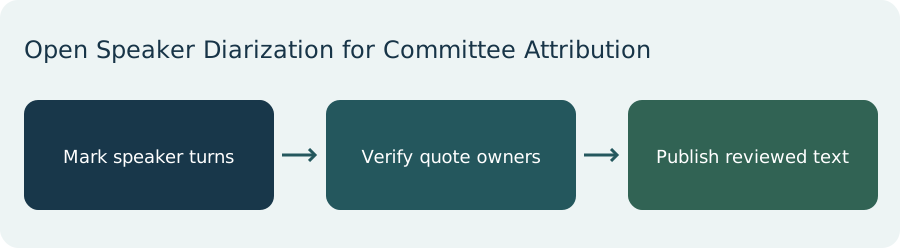
Start with a known section of the recording and assign participant names only where introductions, channel notes or other evidence support the mapping. Give the reviewer a timestamp link and retain the anonymous label alongside the verified name. When a voice overlaps a motion or amendment, flag the span for replay. Keep the raw model transcript available so that an editor can audit what changed.
Frequently asked questions
Can a label identify a person?
Labels describe speaker groupings in a recording. Match them to real names with separate evidence.
Is cpCER interchangeable with diarization error rate?
No. cpCER evaluates text grouped by speakers. A time-based diarization score focuses on who spoke when.
Related reading
Sources
Frequently asked questions
Can a label identify a person?
Labels describe speaker groupings in a recording. Match them to real names with separate evidence.
Is cpCER interchangeable with diarization error rate?
No. cpCER evaluates text grouped by speakers. A time-based diarization score focuses on who spoke when.