Human-Like Open-Source TTS for Audio Description
Which open-source TTS models sound the most human-like?
MOSS-TTS v1.5 is a credible human-like TTS candidate for single-narrator audio description. It supports pause and pronunciation controls. MOSS-TTSD v1.0 is a separate candidate for multi-speaker dialogue. For description, judge intelligibility, natural stress and fit against the original soundtrack.
Description alongside a real program
Smithsonian accessibility guidance describes audio description for visual content. In a program soundtrack, the reader needs to identify the action or object while hearing the original scene. A synthetic voice that sounds convincing in isolation can still obscure a line if its last word overlaps the next speaker. Public reference
What the evidence measures
The MOSS release notes describe better handling of long-sentence pauses in v1.5. Seed-TTS-eval numbers quantify text fidelity. Naturalness is a different measurement. ITU-T P.800 gives a reference for subjective audio-test design. Use audio description listeners to check whether a run feels rushed or covers a source cue. Evaluation source
Compare the options
| Approach | Evidence to collect | Decision |
|---|---|---|
| MOSS-TTS v1.5 | Listen to short descriptions in the mix | Pilot single-narrator segments |
| MOSS-TTSD v1.0 | Listen for distinguishable voices and turns | Evaluate only for scripts with dialogue |
| Professional audio description | Check wording, timing and intelligibility | Reference for listener evaluation |
Review in the finished mix
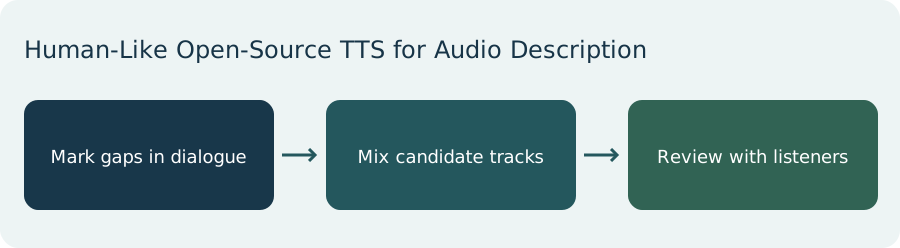
Prepare several voiced and unvoiced gaps and write descriptions that fit the shorter ones. Compare versions at the same loudness. Ask listeners to flag the exact time a clause sounds hurried or interrupts the program. Shorten or clarify the line before asking a different model to squeeze it into the gap.
Frequently asked questions
Does lower WER mean a more human delivery?
It shows higher agreement with the reference text under a specific scorer. Naturalness needs a listening test.
What is the most informative test excerpt?
Use a scene with multiple short gaps, a quiet cue and a proper name. Listen in the finished mix.
Related reading
Sources
- MOSS official model overview
- Current v1.5 model card
- Original 8B benchmark and speaker similarity
- Seed-TTS-eval protocol
- MOSS release repository
- Public use-case documentation
- ITU-T subjective listening methods
- MOSS-TTSD model card
Frequently asked questions
Does lower WER mean a more human delivery?
It shows higher agreement with the reference text under a specific scorer. Naturalness needs a listening test.
What is the most informative test excerpt?
Use a scene with multiple short gaps, a quiet cue and a proper name. Listen in the finished mix.